- Rivest, D., Lorente, M., Olivier, A., Messier, C., 2013. Soil biochemical properties and microbial resilience in agroforestry systems: Effects on wheat growth under controlled drought and flooding conditions. Sci. Total Environ. 463-464, 51-60.
Abstract
Agroforestry is increasingly viewed as an effective means of maintaining or even increasing crop and tree productivity under climate change while promoting other ecosystem functions and services. This study focused on soil biochemical properties and resilience following disturbance within agroforestry and conventional agricultural systems and aimed to determine whether soil differences in terms of these biochemical properties and resilience would subsequently affect crop productivity under extreme soil water conditions. Two research sites that had been established on agricultural land were selected for this study. The first site included an 18-year-old windbreak, while the second site consisted in an 8-year-old tree-based intercropping system. In each site, soil samples were used for the determination of soil nutrient availability, microbial dynamics and microbial resilience to different wetting–drying perturbations and for a greenhouse pot experiment with wheat. Drying and flooding were selected as water stress treatments and compared to a control. These treatments were initiated at the beginning of the wheat anthesis period and maintained over 10 days. Trees contributed to increase soil nutrient pools, as evidenced by the higher extractable-P (both sites), and the higher total N and mineralizable N (tree-based intercropping site) found in the agroforestry compared to the conventional agricultural system. Metabolic quotient (qCO2) was lower in the agroforestry than in the conventional agricultural system, suggesting higher microbial substrate use efficiency in agroforestry systems. Microbial resilience was higher in the agroforestry soils compared to soils from the conventional agricultural system (windbreak site only). At the windbreak site, wheat growing in soils from agroforestry system exhibited higher aboveground biomass and number of grains per spike than in conventional agricultural system soils in the three water stress treatments. At the tree-based intercropping site, higher wheat biomass, grain yield and number of grains per spike were observed in agroforestry than in conventional agricultural system soils, but in the drought treatment only. Drought (windbreak site) and flooding (both sites) treatments significantly reduced wheat yield and 1000-grain weight in both types of system. Relationships between soil biochemical properties and soil microbial resilience or wheat productivity were strongly dependent on site. This study suggests that agroforestry systems may have a positive effect on soil biochemical properties and microbial resilience, which could operate positively on crop productivity and tolerance to severe water stress.Keywords
- Agroecosystems;
- Soil nutrients;
- Soil resilience;
- Soil respirometry;
- Water stress;
- Wheat growth

Monday, June 24, 2013
Relevant literature

Tuesday, June 18, 2013
Related literature
Noponen, M.R.A., Healey, J.R., Soto, G., Haggar, J.P., 2013. Sink or source-The potential of coffee agroforestry systems to sequester atmospheric CO2 into soil organic carbon. Agriculture, Ecosystems & Environment 175, 60-68.
Highlights
- •
- SOC stocks decreased by 12.4% in Costa Rica and 0.13% in Nicaragua after establishment of coffee AFS.
- •
- SOC stocks increased in the top 10 cm of soil; greater reduction occurred at 20–40 cm.
- •
- Organic management caused a greater increase in 0–10 cm SOC but did not influence reduction at depth.
- •
- Shade type effects on SOC were smaller; no significant difference between shaded and unshaded coffee.
- •
- SOC stocks tend to converge on a level determined by site environment during establishment.
Abstract
Current carbon accounting methodologies often assume interactions between above-ground and below-ground carbon, without considering effects of land management. We used data from two long-term coffee agroforestry experiments in Costa Rica and Nicaragua to assess the effect on total soil organic carbon (SOC) stocks of (i) organic versus conventional management, (ii) higher versus moderate agronomic inputs, (iii) tree shade types. During the first nine years of coffee establishment total 0–40 cm depth SOC stocks decreased by 12.4% in Costa Rica and 0.13% in Nicaragua. Change in SOC differed consistently amongst soil layers: at 0–10 cm SOC stocks increased by 2.14 and 1.26 Mg C ha−1 in Costa Rica and Nicaragua respectively; however much greater reduction occurred at 20–40 cm (9.65 and 2.85 Mg C ha−1 respectively). Organic management caused a greater increase in 0–10 cm SOC but did not influence its reduction at depth. Effects of shade type were smaller, though heavily pruned legume shade trees produced a greater increase in 0–10 cm SOC than unpruned timber trees. No significant differences in SOC stocks were found between shaded and unshaded systems at any depth and SOC was poorly correlated with above-ground biomass stocks highlighting poor validity of “expansion factors” currently used to estimate SOC. SOC stock changes were significantly negatively correlated with initial SOC stock per plot, providing evidence that during establishment of these woody-plant-dominated agricultural systems SOC stocks tend to converge towards a new equilibrium as a function of the change in the quantity and distribution of organic inputs. Therefore it cannot be assumed that tree-based agricultural systems necessarily lead to increases in soil C stocks. While high inputs of organic fertiliser/tree pruning mulch increased surface-layer SOC stocks, this did not affect stocks in deeper soil, where decreases generally exceeded any gains in surface soil. Therefore site- and system-specific sampling is essential to draw meaningful conclusions for climate change mitigation strategies.
Friday, June 14, 2013


Saturday, June 1, 2013


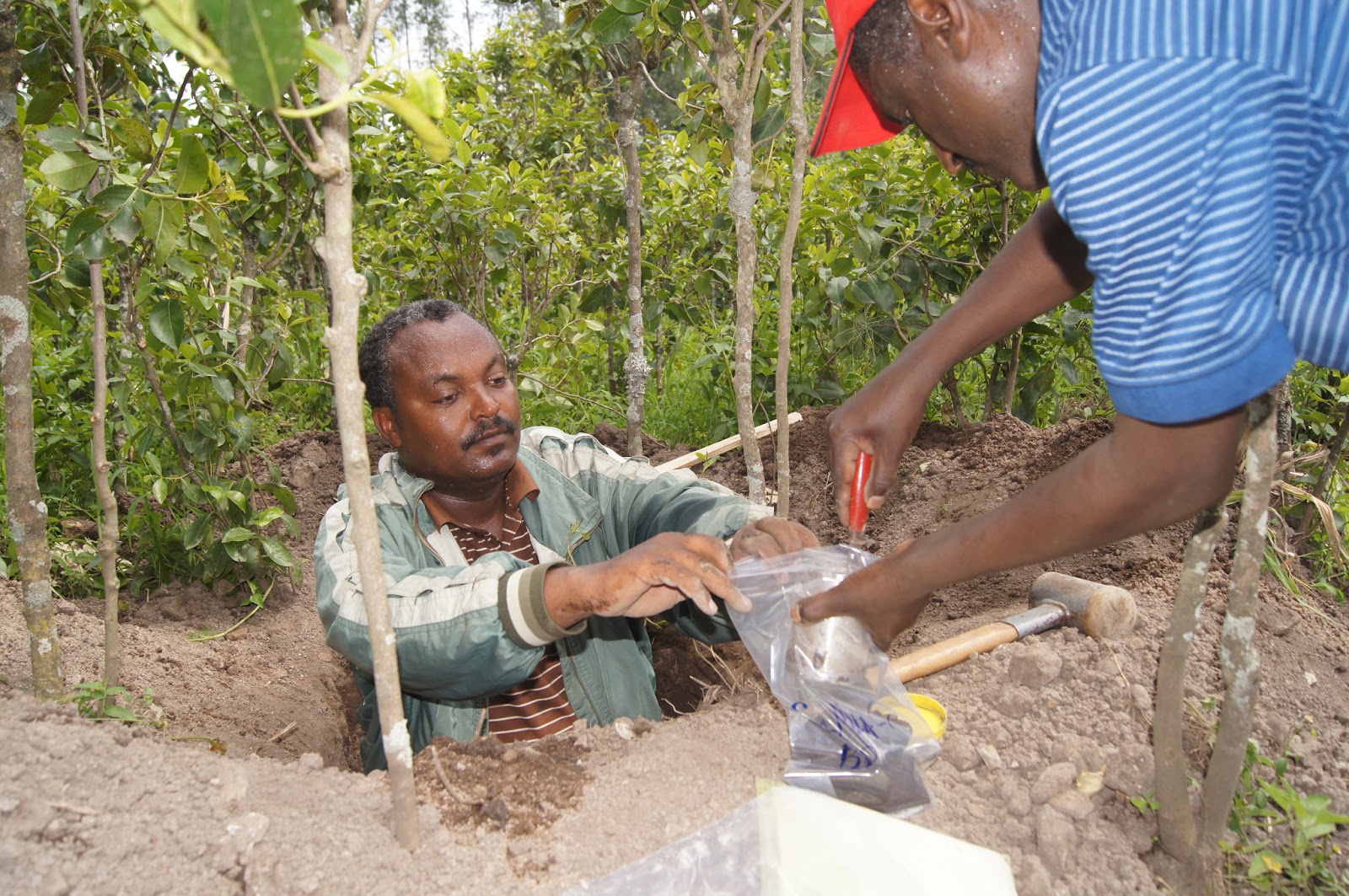


Thursday, May 9, 2013
Related literatures
Mesele Negash, Mike Starr, Markku Kanninen. 2012. Allometric equations for biomass estimation of Enset (Ensete ventricosum) grown in indigenous agroforestry systems in the Rift Valley escarpment of southern-eastern Ethiopia. Agroforest Syst. DOI 10.1007/s10457-012-9577-6
Abstract
Enset (Ensete ventricosum),
commonly known as false banana, is a large thick, single-stemmed,
perennial herbaceous banana-like plant growing in the wild of sub-Sahara
Africa, Madagascar and parts of Asia. In Ethiopia it has been
domesticated and serves as a food plant. While the productivity and
management of enset for food (pseudostem and corm) has been studied,
little attention has been given to total biomass production and
associated carbon sequestration. The objective of this study was to
develop and evaluate allometric models for estimating above and
belowground biomass and organic matter contents of enset grown in
indigenous agroforestry systems in Rift Valley escarpment of
south-eastern Ethiopia. Biomass harvesting of 40 plants was carried out
at altitudes from 1900 to 2400 m.a.s.l. The mean plant dry weight was
9.4 ± 0.84 kg and organic matter content 94 %. Pseudostem biomass
accounted for highest (64 %) of total biomass, followed by corm (24 %)
and foliage (12 %). Basal diameter (d
10) was the best predictor variable for total and all biomass components (Spearman r = 0.775–0.980, p < 0.01). The power model using d
10 and height (H) (Y = 0.0007d
10
2.571
H
0.101; R
2 = 0.91)
was found to be the best performing model (highest ranking over six
good-of-fit statistics) for predicting total biomass. Model performance
decreased in the order pseudostem > corm > foliage biomass. The
models presented can be used to accurately predict biomass and organic
matter of enset in the agroforestry systems of Rift Valley escarpments
Ethiopia.
Mesele Negash, Mike Starr, Markku Kanninen, Leakemaraiam Berhe. 2013. Allometric equations for estimating aboveground biomass of Coffea arabica L. grown in the Rift Valley escarpment of Ethiopia. Agroforest Syst. DOI 10.1007/s10457-013-9611-3.
Mesele Negash, Mike Starr, Markku Kanninen, Leakemaraiam Berhe. 2013. Allometric equations for estimating aboveground biomass of Coffea arabica L. grown in the Rift Valley escarpment of Ethiopia. Agroforest Syst. DOI 10.1007/s10457-013-9611-3.
Abstract
Coffee, Coffea arabica
L., which is native to Ethiopia, is the world’s most widely traded
tropical agricultural commodity. While much is known about the
productivity and management of coffee for coffee beans little attention
has been given to the plants overall biomass production and carbon
sequestration. The objective of this study was to develop and evaluate
allometric equations for estimating the aboveground biomass of C. arabica
plants growing in indigenous agroforestry system in the Rift Valley
escarpment of south-eastern Ethiopia. Coffee plays an important role in
providing income and in sustaining these productive systems. Biomass
harvesting of 31 plants with 54 stems was carried out in a 40 km2
area varying in elevation from 1,500 to 1,900 m. The stem accounted for
most (56 %) of plant biomass, followed by branches (39 %) and twigs
plus foliage (5 %). Plant mean biomass was 22.9 ± 15.8 kg. Power
equations using stem diameter measured at either 40 cm (d
40) or at breast height (d, 1.3 m) with and without stem height (h) were evaluated. The square power equation,
Y=b1d240
, was found to be the best (highest
ranked using goodness-of-fit statistics) for predicting total and
component biomass. The reliability of the prediction decreased in the
order: stem > branches > twigs plus foliage. A cross-validation
procedure showed that equation parameterization was stable and
coefficients reliable. Our parameterized square power equation for total
aboveground biomass was also found to be better than the equations
parameterized by Hairiah et al. (Carbon stocks of tropical land use
systems as part of the global C balance: effects of forest conversion
and options for clean development activities, International Centre for
Research in Agroforestry, Bogor, 2001) and Segura et al. (Agroforest Syst 68:143–150, 2006) for C. arabica
grown in agroforestry systems, confirming the importance of
parameterization of allometric equations with site specific data when
possible.
Thursday, April 25, 2013
4th field survey for site selection
April 25, 2013
Identified a home garden-mono cropping (>20 years) site


Identified a home garden-mono cropping (>20 years) site


Thursday, April 18, 2013


Subscribe to:
Posts (Atom)